
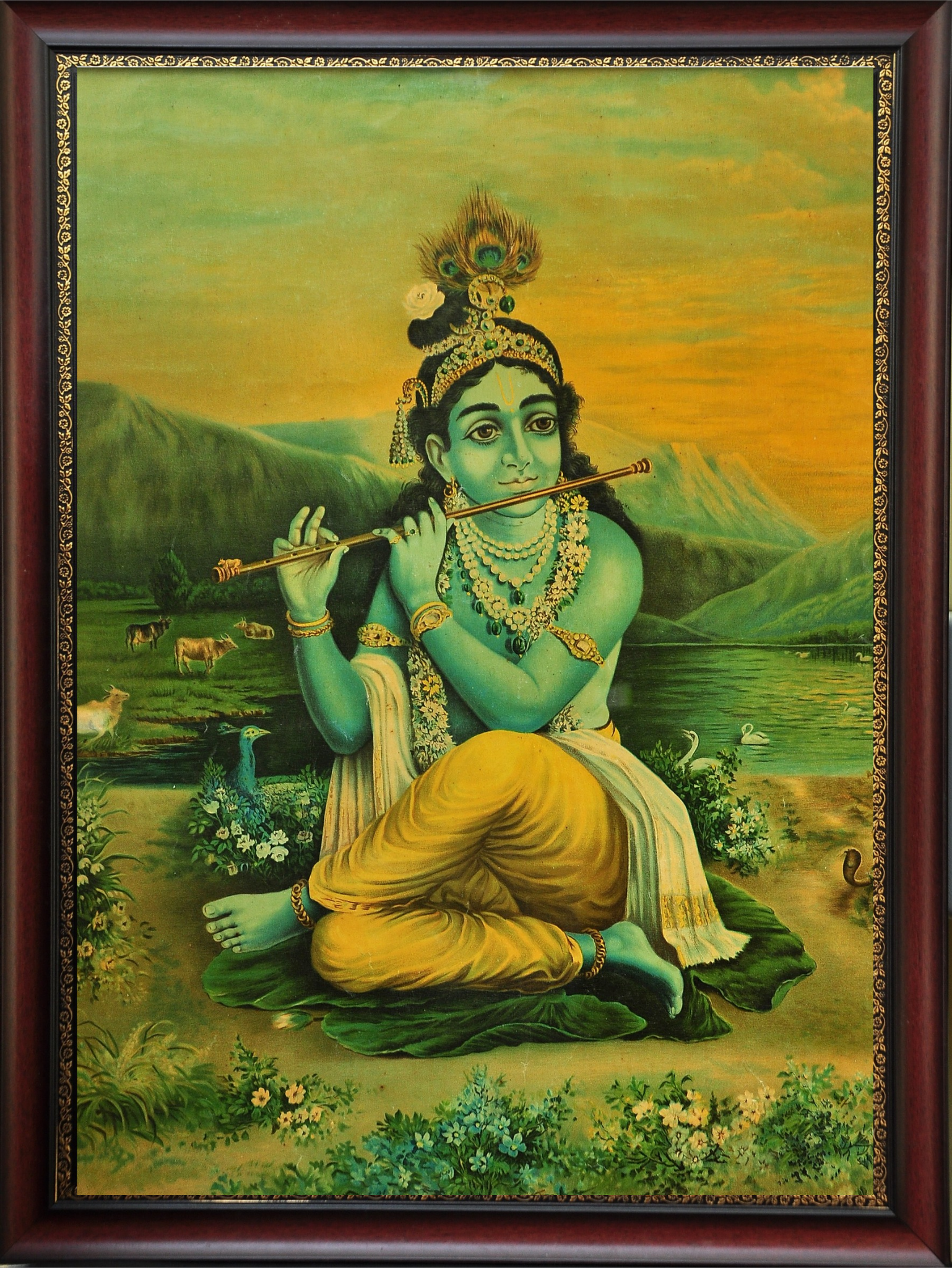
Painted in 1927
Murali Krishna
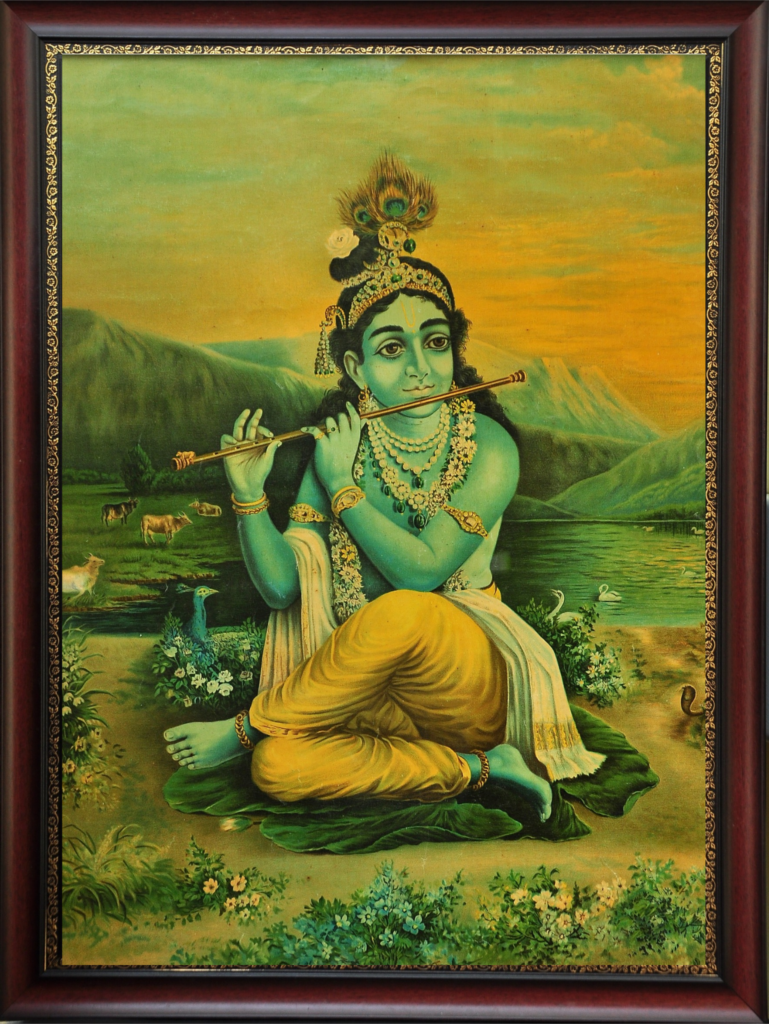
This stunning painting of Murali Krishna, created by N. Gopala Rao as an oil on canvas in 1927, fetched an impressive sum of 60,000 rupees and was printed in Germany , this work set a record for the highest price ever paid for a painting in Indian rupees at that time, a milestone unmatched by any other Indian artist of the period. The elements within the painting reflect the artist’s imagination and deep love for nature. The vibrant colour combinations and intricate details garnered significant recognition for the painter among his contemporaries.
In the artwork, Lord Krishna is depicted seated on a lotus leaf, completely absorbed in playing his flute, surrounded by peacocks, swans, cows, snakes, and mountains, with a pond in the background. The animals are captivated by Krishna’s music, and he revels in the joy of playing. Notably, the intricate detail of a calf at the tip of his flute showcases the artist’s skill. Krishna’s large eyes and exquisite jewelry are rendered beautifully, highlighting the artist’s talent.
The name “Murali Krishna” translates to “Krishna with the flute” in Hindi and Sanskrit, with “Murali” specifically referring to the flute that Krishna is often portrayed playing. This symbolizes his enchanting music, which captivates all beings and embodies divine love and joy. The peacock feather is a constant companion of Lord Krishna, further enhancing his playful and loving nature.
Krishna is often associated with themes of playfulness, love, and spiritual wisdom. His flute music attracts not only the gopis (milkmaids) but also nature itself, underscoring his role as a divine lover and the embodiment of bliss. The image of Murali Krishna beautifully reflects the harmony between the divine and earthly realms, encapsulating his ability to bring joy and transcendental experiences to those who listen to his music.
This particular Murali Krishna painting was oleographed in Germany, similar to other oleographs. However, it is more commonly found adorning the entrances of houses and temples in South India.
Murali Krishna, often simply referred to as Krishna, is a central figure in Hindu mythology and is revered as the eighth avatar of Vishnu. His stories are rich and varied, blending philosophy, devotion, and playful mischief. Here’s an overview of his key tales:
Birth and Early Life
Krishna was born in a prison cell in Mathura to Devaki and Vasudeva. His birth was prophesied to bring about the downfall of the tyrant king Kansa, Devaki’s brother. To protect him, Vasudeva smuggled the newborn Krishna to the village of Gokul, where he was raised by Nanda and Yashoda.
Childhood Adventures
Krishna’s childhood is filled with miraculous deeds and playful exploits. He is known for his love of butter, often stealing it from the homes of the gopis (milkmaids). His playful nature earned him the nickname “Makhan Chor” (butter thief). He also defeated various demons sent by Kansa, including Putana, a shape-shifting witch, and Trinavarta, a whirlwind demon.
Youth and Love
As he grew older, Krishna became famous for his divine love stories, particularly with Radha, his beloved. Their relationship symbolizes the soul’s yearning for the divine. The Raas Leela, a dance performed by Krishna with the gopis, is a celebration of this love and devotion.
The Mahabharata and Bhagavad Gita
Krishna plays a crucial role in the Mahabharata as a friend and charioteer to Arjuna. During the great Kurukshetra war, he imparts the teachings of the Bhagavad Gita, addressing Arjuna’s doubts about duty, righteousness, and the nature of the self. This text is one of the most important scriptures in Hindu philosophy.
Teachings and Philosophy
Krishna’s teachings emphasize dharma (righteousness), bhakti (devotion), and the importance of surrendering to the divine will. His life embodies the principles of love, compassion, and selfless service.
Conclusion
Krishna’s stories continue to inspire millions, celebrating the divine play (lila) and the profound truths of existence. He is worshipped in various forms across India and beyond, symbolizing love, joy, and the ultimate truth. His legacy endures through festivals, art, and spiritual practices, making him one of the most beloved deities in Hinduism.
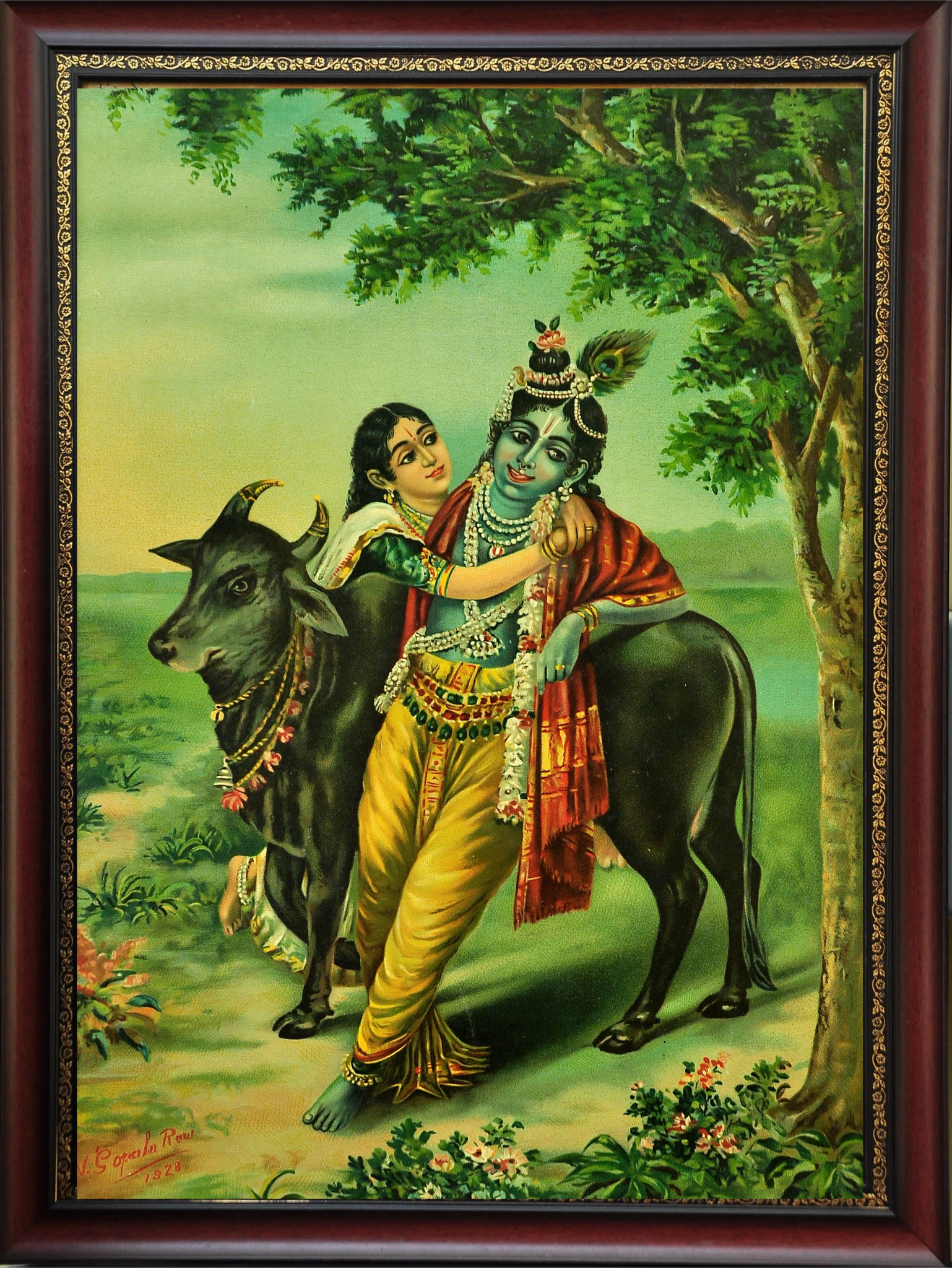
Painted in 1928
Radha and Krishna
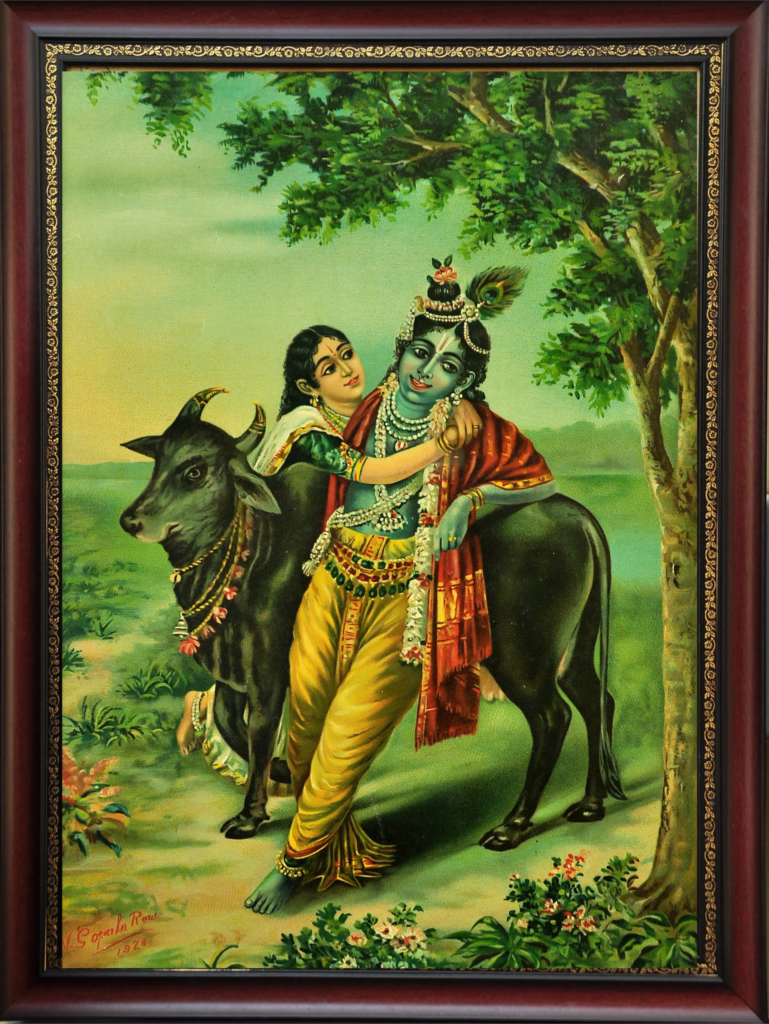
In 1928, N. Gopala Rao painted his depiction of Radha and Krishna, contributing numerous artworks featuring Lord Sri Krishna. One notable piece is the Radha Krishna painting, distinguished by its striking use of bright colors. These vibrant hues showcase the artist’s vivid imagination in the portrayal of clothing and background, enhancing the painting’s beauty and elegance.
In this enchanting artwork, Krishna is depicted leaning against a cow, immersed in the love of Radha. He is adorned with exquisite ornaments and a lovely garland of flowers, symbolizing his charm. Krishna is typically shown as a young figure with deep blue skin, representing the infinite sky or the depths of the ocean. His playful nature adds a melodic essence to the scene, captivating both Radha and the cow.
Radha, portrayed with grace and beauty, is adorned with intricate patterns and jewellery . Her expressions convey deep love and devotion, often gazing at Krishna with adoration. The cow, a symbol of nurturing and abundance, stands nearby, reflecting the pastoral setting and enhancing the divine atmosphere.
Surrounding them, lush greenery filled with blooming flowers and trees creates a serene backdrop, emphasizing the purity and beauty of their relationship. The overall composition radiates a sense of peace, love, and the joyful spirit of their divine play.
The Love Story of Radha and Krishna
Divine Connection
Radha and Krishna’s love story transcends the earthly realm, embodying a profound spiritual connection. Their bond symbolizes the relationship between the soul and the divine, with Radha representing the devoted soul and Krishna as the Supreme Being.
Childhood Innocence
In the idyllic village of Vrindavan, Radha and Krishna’s love blossoms during their childhood. They play together, share laughter, and engage in playful mischief, laying the foundation for their deep emotional bond.
The Enchantment of Flute
Krishna’s enchanting flute music captivates not only Radha but also all the gopis (cowherd maidens) of Vrindavan. Radha, drawn by his melodies, experiences an overwhelming sense of love and devotion, highlighting the magnetic pull of Krishna’s divine charm.
The Raas Leela
One of the most celebrated events in their love story is the Raas Leela, a divine dance in which Krishna dances with Radha and the other gopis. This ethereal celebration of love and joy showcases the playful, romantic aspect of their relationship, representing the bliss of divine love.
Separation and Longing
Despite their deep connection, circumstances lead to moments of separation. Radha and Krishna experience intense longing for each other, symbolizing the soul’s yearning for union with the divine. These moments of separation deepen their love and devotion, making it all the more profound.
The Eternal Love
Radha and Krishna’s love is eternal, existing beyond time and space. Their relationship is celebrated in various texts, songs, and art, symbolizing the idea that true love is unconditional and transcends physical existence.
Symbol of Devotion
The story of Radha and Krishna serves as an inspiration for devotees, emphasizing the importance of love, devotion, and surrender to the divine. Their love story teaches that true devotion leads to a deeper understanding of the spiritual connection between the lover and the beloved.
Conclusion
The love story of Radha and Krishna is not just a tale of romance; it is a spiritual narrative that illustrates the depths of love and devotion. Their relationship continues to inspire millions, serving as a reminder of the divine connection that exists within each soul.
Painted in 1928
Sriman Narayana
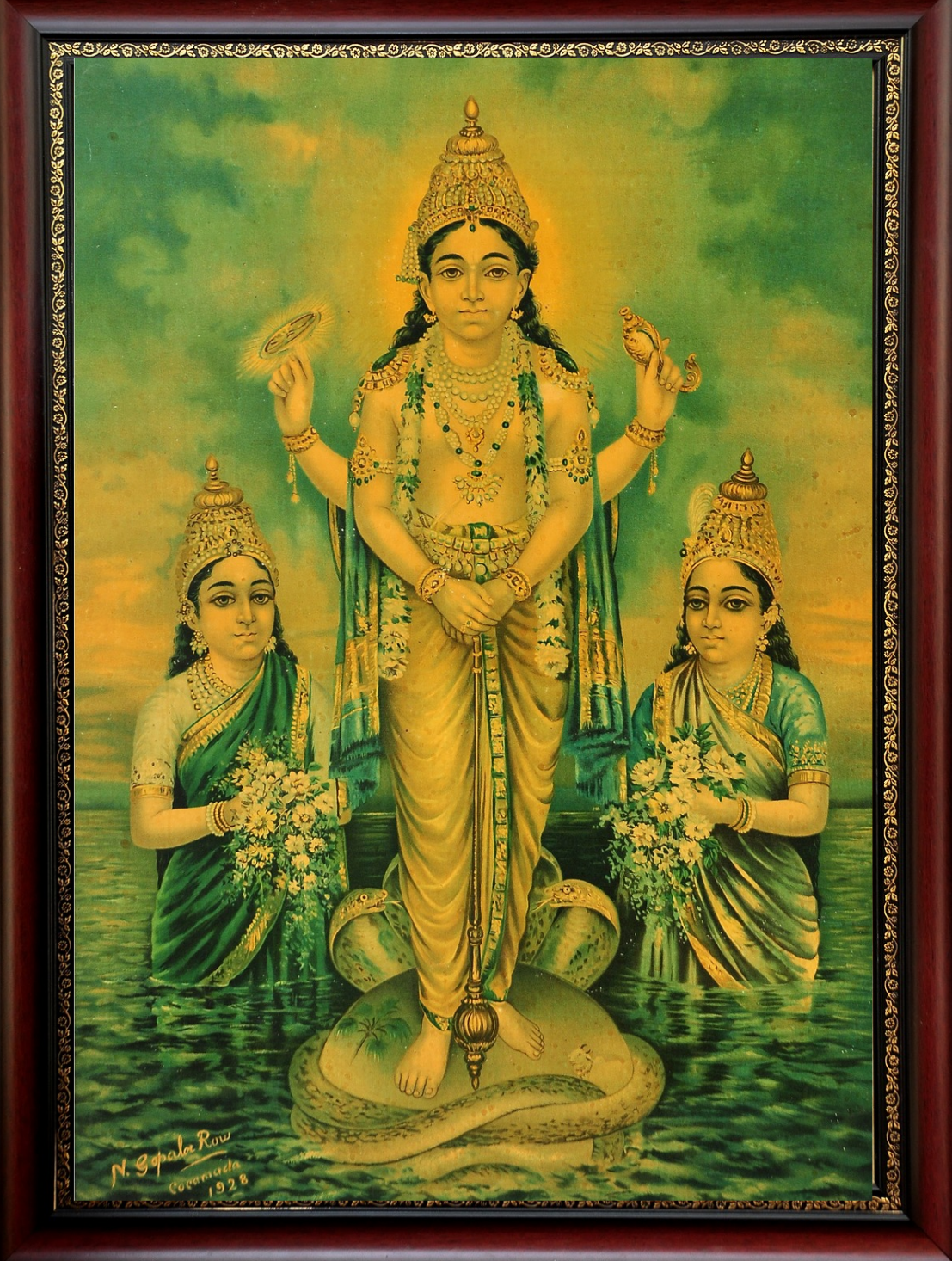
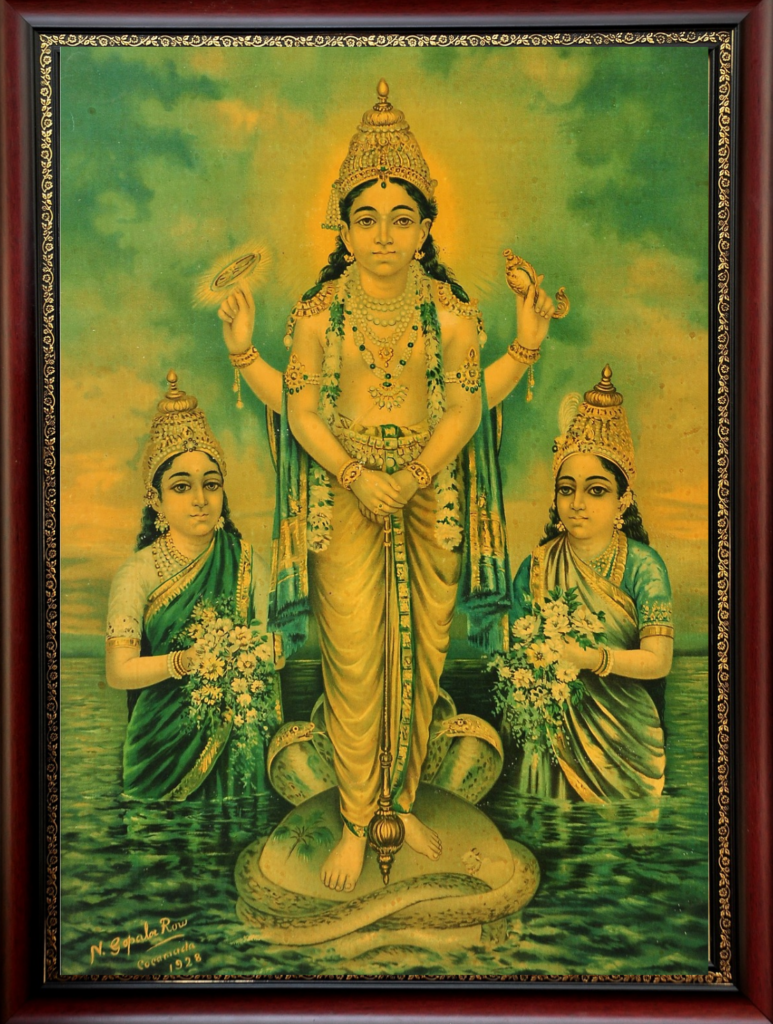
Sriman Narayana was his next masterpiece, created in 1928. In this work, the timeless beauty of ancient mythology comes to life through N. Gopala Rao’s rich and warm colours. His paintings radiate a divine beauty that invites worship. The vibrant hues in “Sriman Narayana” highlight the artist’s skillfull use of colour. The portrait captures Vishnu’s manifestation as Sriman Narayana, who resides on the milk ocean. He is depicted as the inner essence of all beings, from the tiniest ant to the four-headed Brahma. Vishnu is typically shown holding significant attributes: a conch shell in his upper left hand, symbolizing creativity; a chakra in his upper right hand, representing the mind; a mace signifying individual existence; and a lotus flower, which embodies liberation, this divine figure rests upon the “Kshira Sagar” (ocean of milk). In various scriptures, especially the Puranas, Vishnu is revered as Sriman Narayana
The painting depicts Sriman Narayana adorned with exquisite jewellery and ornaments, featuring a vibrant garland of flowers cascading from his neck. On either side of him stand his two wives, Lakshmi and Padmavathi, each holding flowers. Each of the women showcases unique styles of jewellery, enhancing the overall splendor of the scene.
They emerge gracefully from the ocean, with Sriman Narayana positioned on the tranquil ocean of milk at his feet. To his left, a Tree of Life is beautifully illustrated, while a cow is depicted on his right. the Tree of Life is a powerful representation of growth, fertility, and interconnectedness among all living beings. It signifies the nurturing aspects of the divine, embodying the idea that life is cyclical and that all forms of existence are interrelated. The roots of the tree often symbolize the past and stability, while the branches reaching towards the sky represent aspirations and spiritual growth. In the context of Sriman Narayana, the Tree of Life underscores his role as the sustainer of life and the source of nourishment for all creatures.
The cow holds a particularly revered place in Hindu culture, symbolizing abundance, motherhood, and the spirit of selfless giving. It is seen as a source of sustenance, providing milk and other resources, and represents the nurturing qualities of nature. In many texts, the cow is associated with various deities, and its presence in art often signifies prosperity and blessings.
When depicted alongside Sriman Narayana on the ocean of milk, the Tree of Life and the cow work together to highlight his divine role as a protector and sustainer of all life. The ocean of milk itself symbolizes the primordial ocean from which creation emerged, a cosmic expanse that signifies both potential and transformation. This imagery emphasizes that from this divine source, all forms of life are nourished and sustained, reflecting the harmony between the divine and the natural world. Overall, these elements convey a rich tapestry of meanings related to sustenance, growth, and the interconnectedness of existence, reinforcing Sriman Narayana’s significance in the Hindu faith as a guardian of life and abundance.
The story of Sriman Narayana as Vishnu, who resides on the milk ocean (Ksheer Sagar), is a significant aspect of Hindu cosmology and mythology. It beautifully illustrates the themes of creation, preservation, and the eternal cycle of life.
The Cosmic Context
In Hindu mythology, Vishnu is one of the principal deities, often referred to as the preserver of the universe. He is part of the Trimurti, alongside Brahma the creator and Shiva the destroyer. The narrative often begins with the concept of the cosmic ocean of milk, Ksheer Sagar, which symbolizes the primordial state of existence.
The Churning of the Ocean
The most famous story associated with Vishnu and the milk ocean is the “Samudra Manthan,” or the churning of the ocean. The Devas (gods) and Asuras (demons) sought to obtain the nectar of immortality (amrit). To achieve this, they decided to churn the milk ocean, using Mount Mandara as the churning rod and the serpent Vasuki as the rope.
Vishnu’s Role
During this cosmic event, the ocean yielded many treasures, including the goddess Lakshmi, who emerged as the personification of wealth and prosperity. Vishnu, in his divine form, played a crucial role in ensuring that the Devas obtained the nectar. To protect the Devas and maintain cosmic order, he took on the form of a beautiful enchantress (Mohini) to distract the Asuras and ensure the Devas received the amrit.
Vishnu on the Serpent
In some depictions, Vishnu is shown reclining on the serpent Ananta Shesha (or Adishesha), who represents the infinite. This image symbolizes the balance of creation and the infinite nature of the cosmos. Vishnu is often portrayed resting on Shesha, surrounded by the serene waters of the milk ocean, reflecting tranquility and omnipotence.
Conclusion
This rich tapestry of stories emphasizes Vishnu’s role as the protector and preserver, maintaining balance and harmony in the universe. His abode on the milk ocean, coiled by the serpent, serves as a metaphor for stability amidst chaos, illustrating his significance in Hindu spirituality and cosmology.
Painted in 1928
Uluchi Arjun
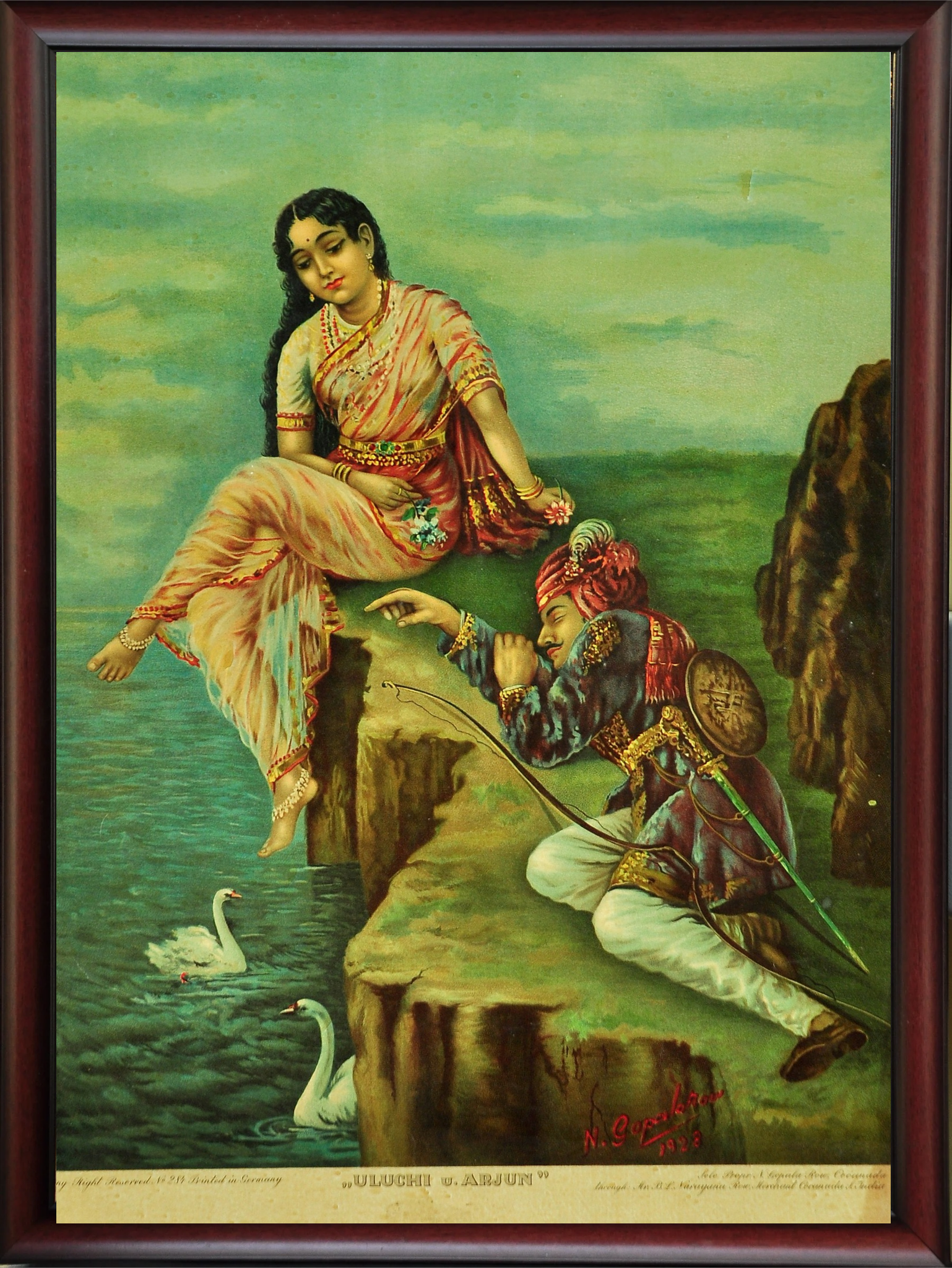
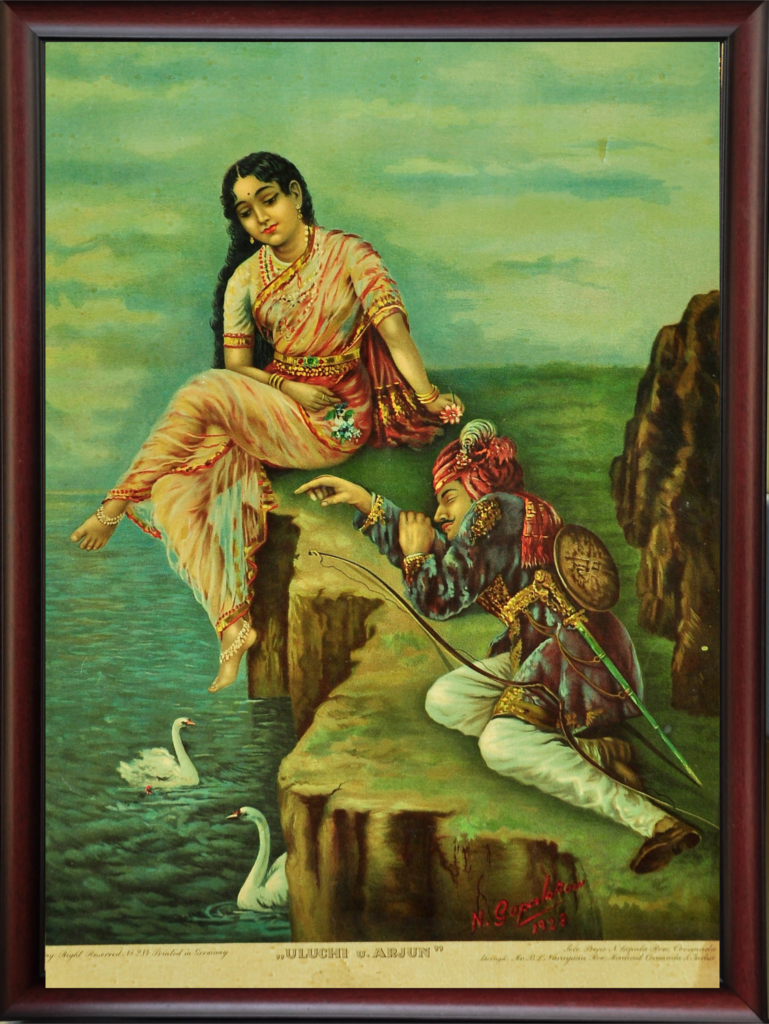
N. Gopala Rao crafted “Uluchi Arjun” in 1928, capturing the essence of Arjuna, a central hero from the Hindu epic Mahabharata. The narrative unfolds as Arjuna, accompanied by a group of Brahmins, departs from Indraprastha for a sacred pilgrimage. His journey begins at the banks of the Ganges, where he immerses himself in the holy waters and listens to tales of his ancestors.
Amidst this serene backdrop, a Naga princess named Uluchi wanders along the riverbank and becomes enchanted by Arjuna. After intoxicating him with her potent brews, she lures him away to her realm in the netherworld. There, Uluchi, determined to claim him, persuades a reluctant Arjuna to take her as his bride.
In this painting, Gopala Rao’s artistry shines through with its rich colors and sensual subject matter. A self-taught artist, he carved his own path, creating a captivating narrative without the guidance of a traditional master. In this mesmerizing scene, Arjuna lies asleep upon a rocky mountain perch, clad in armor, while Uluchi gazes at him lovingly, embodying both allure and tenderness. Below them, two elegantly painted swans add to the enchanting atmosphere, enhancing the beauty of the moment.
Uluchi’s story with Arjuna in the Mahabharata is rich in symbolism and explores themes of love, duty, and the complexities of relationships.
Background
During the Pandavas’ exile, Arjuna embarked on a journey to acquire divine weapons. In this quest, he traveled through various lands, where he encountered different beings and faced numerous challenges. It was during this time that he arrived at the territory of the Nagas, where he met Uluchi.
Uluchi’s Character
Uluchi is portrayed as a strong and independent woman, a daughter of the Naga king. She is not only beautiful but also possesses immense wisdom and skills in combat. Her heritage ties her to the mystical world of serpents, making her a unique character in the epic.
The Meeting
When Arjuna first meets Uluchi, he is struck by her beauty and grace. Uluchi, too, is enchanted by Arjuna, recognizing him as a great warrior and hero. Their meeting is marked by a sense of destiny, as both feel a deep connection despite the societal norms that separate them.
The Development of Their Relationship
As their bond grows, Uluchi expresses her feelings openly. Arjuna, initially hesitant due to his duties and the complexities of his existing relationships, finds himself drawn to her passion and strength. Their romance is characterized by mutual respect and admiration, showcasing a partnership based on shared values.
Challenges
The love between Uluchi and Arjuna is not without obstacles. Arjuna is bound by his vows and responsibilities to the Pandavas and their kingdom. Moreover, he is already married to several women, including Draupadi, Subhadra, and others. The dynamics of his relationships add layers of conflict and tension.
Union and Acceptance
Eventually, Arjuna and Uluchi’s love prevails, and she becomes one of his wives. Their union signifies a blend of different worlds—human and divine, as well as warrior and serpent. This relationship is an embodiment of acceptance, as Uluchi fully embraces Arjuna’s life, and he respects her identity.
Legacy
Uluchi and Arjuna’s story, while a smaller narrative within the vast Mahabharata, enriches the tapestry of relationships in the epic. It illustrates that love can transcend boundaries, and that different cultures and backgrounds can unite through shared experiences and deep emotional connections.
Conclusion
Uluchi’s love for Arjuna stands as a testament to the complexities of love within the framework of duty and destiny, reflecting the overarching themes of the Mahabharata, where every character’s choices resonate through time, impacting the larger narrative. Their relationship is a reminder of the beauty and challenges of love, even amidst the turmoil of war and obligation.
Painted in 1929
Uthra Abimanya
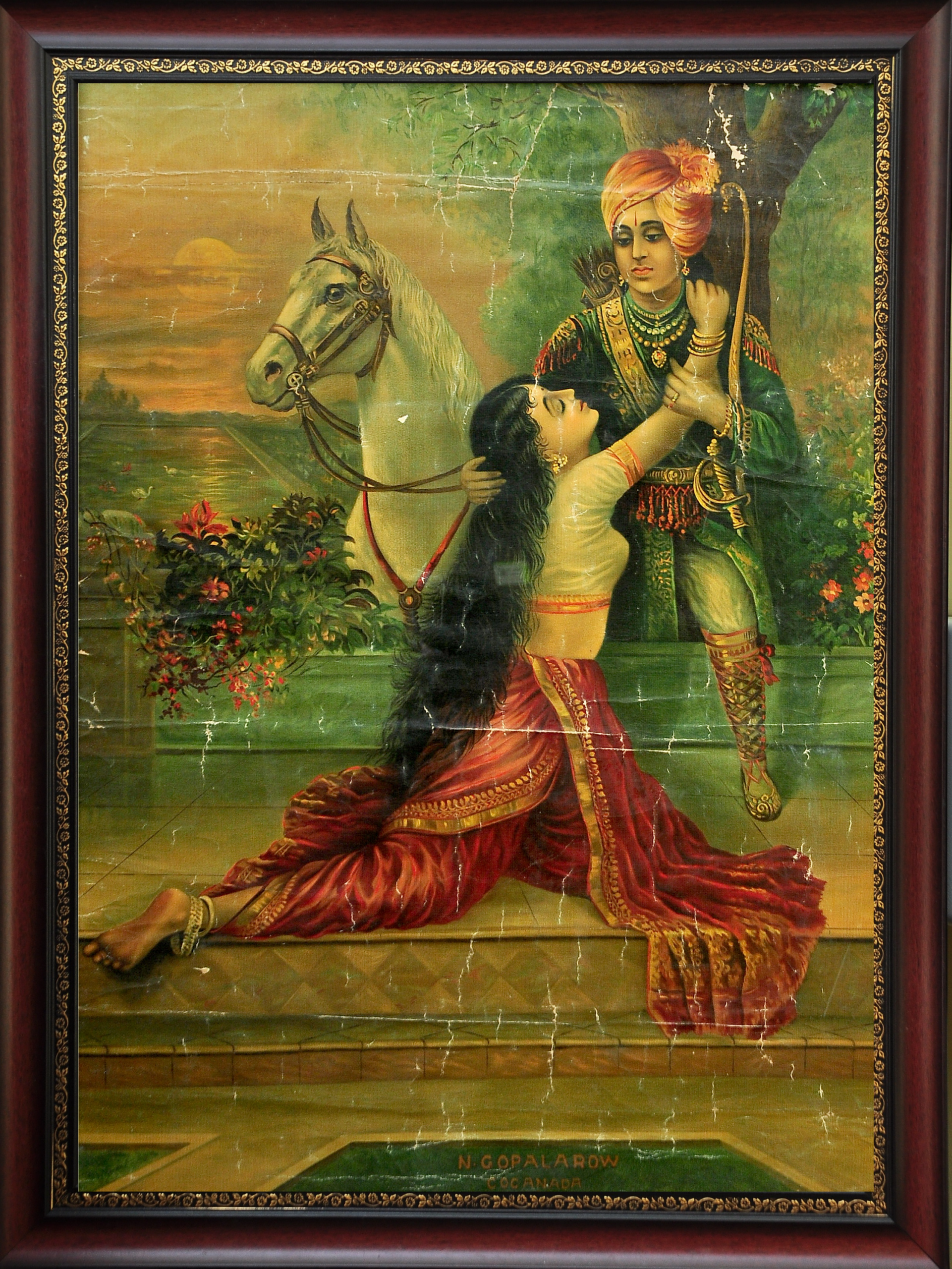
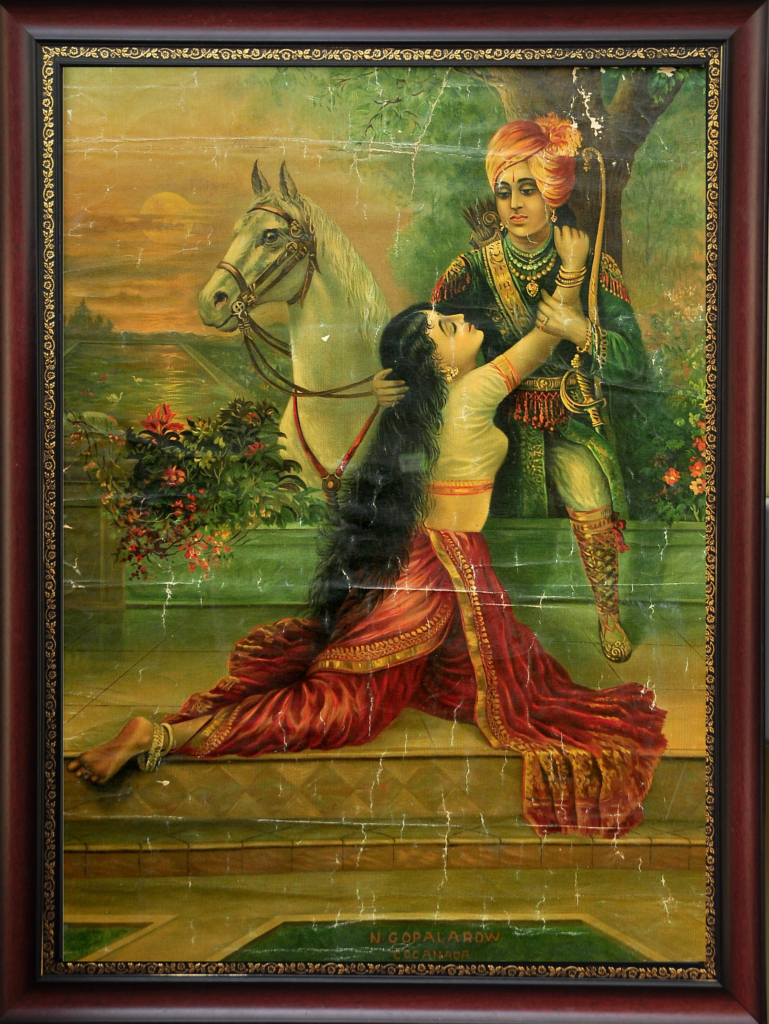
N. Gopala Rao’s 1929 masterpiece “Uthra Abimanyu” captures a poignant moment as Abhimanyu comforts Uttarā before heading into battle. The painting received such acclaim that the artist later created another version in which Uthra’s eyes are open.
Drawing inspiration from the “Virata Parvam” chapter of the Mahabharata, the artwork poignantly portrays the love between Uthra, daughter of King Virata, and Abimanyu, son of Arjuna. Gopala Rao’s skill is evident in the meticulous details, including the graceful folds of Uthra’s saree, highlighting his artistic vision.
The color palette is striking, combining vibrant reds, greens, and golds to create an emotionally charged atmosphere. A passionate admirer of flowers, Gopala Rao often included floral motifs in his paintings, adding richness to both the background and foreground. His unique talent allows viewers to engage with the narrative in a way that few other artists can achieve, with themes of love, duty, and valor resonating powerfully throughout this heartfelt moment.
In the painting, Uthara is shown kneeling as she embraces Abimanyu with her right hand, while he holds her tightly with both arms. Her expression reflects her sorrow at the prospect of his departure for war, revealing her deep love and reluctance to let him go. Abimanyu, dressed in impressive warrior garb, is rendered with exquisite detail. The background features a rising sun and a robust horse, symbolizing readiness for combat and enhancing the painting’s overall emotional weight.
The Heart-Wrenching Farewell: Abhimanyu and Uttara
Their Meeting
Uttara is the daughter of King Virata, and Abhimanyu is the son of Arjuna and Subhadra. Their paths cross during the Pandavas’ exile when they are in hiding in Virata’s kingdom. Abhimanyu, known for his valor and skill in battle, captures Uttara’s heart. Their love blossoms amidst the backdrop of impending conflict, as the tensions between the Pandavas and Kauravas build.
The Promise of Love
Abhimanyu and Uttara’s relationship deepens, filled with dreams of a future together. They exchange promises of love and commitment, envisioning a life beyond the war that looms on the horizon. However, their happiness is overshadowed by the foreboding sense of the great battle that is about to unfold.
The Call to War
As the Kurukshetra war approaches, Abhimanyu must answer the call of duty. The night before he leaves for battle, he and Uttara share an emotional farewell. Uttara, fearing for his life, pleads with him to stay, but Abhimanyu reassures her, promising to return. He speaks of their future together and their child, filling her heart with hope, even as doubt lingers in her mind.
The Tragic Battle
During the war, Abhimanyu fights bravely, showcasing his incredible skills. However, he is ultimately trapped in a vicious attack by several Kaurava warriors who take advantage of his youth and inexperience. In a heartbreaking turn of events, he is killed in battle, leaving Uttara to face the devastating reality of his loss.
The Aftermath
Uttara, who is pregnant at the time of Abhimanyu’s death, is consumed by grief. She mourns the loss of her beloved and the future they had dreamed of together. Despite her sorrow, she gives birth to their son, Parikshit, who becomes the last ruler of the Pandavas’ lineage. Parikshit grows up to carry the legacy of his father and his heroic lineage.
Legacy of Love
The love story of Uttara and Abhimanyu, though marked by tragedy, is a testament to the enduring nature of love amidst the chaos of war. Their brief romance highlights the sacrifices made for duty and the personal tragedies that unfold in the larger narrative of the Mahabharata. Their son, Parikshit, symbolizes hope and continuity, ensuring that their love story lives on through generations.
Painted in 1929
Chitrangi
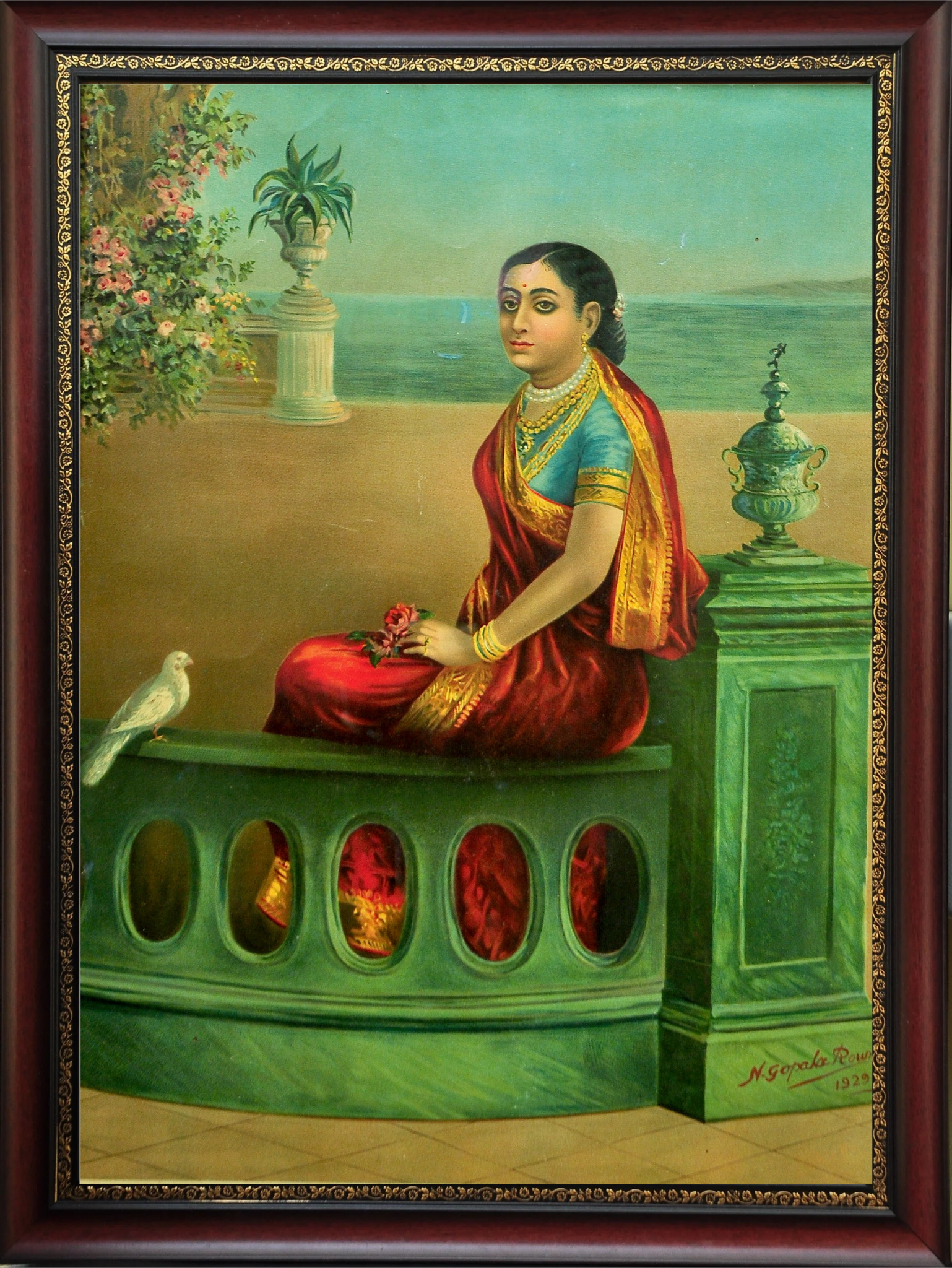
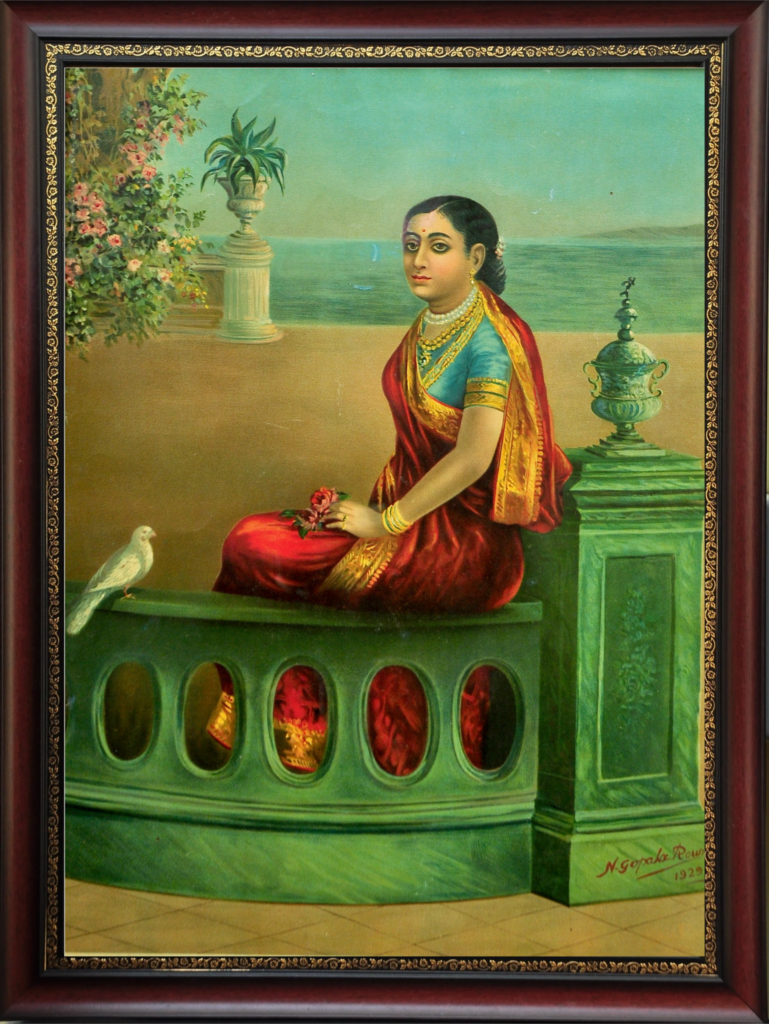
Chitrangi is one of the many remarkable works by N. Gopala Rao, created in 1929. In this painting, the artist beautifully captures the innate grace of the Indian woman, Chitrangi. Gopala Rao employs vibrant colours that enhance her beauty and elegance. The striking red sari and intricate jewellery, combined with the picturesque background, bring the scene to life.
The painting sounds incredibly evocative. Chitrangi’s attire and the setting emphasize her royal status, while the pearls and gold ornaments suggest wealth and beauty. However, her loneliness despite these riches highlights a poignant contrast between material wealth and emotional fulfillment.
The rose in her hand might symbolize both love and longing, enhancing the theme of unrequited love. The sea and distant mountains in the background could represent both the vastness of her desires and the emotional distance from her beloved.
N.Gopala rao’s artwork seems to capture a deep sense of yearning and the idea that true happiness comes from connection rather than possessions. It’s a powerful reminder that even those who appear to have it all can feel profound loneliness.
Chitrangi: The Tragic Heroine of Sarangadhara
Introduction to the Tale
Chitrangi is the romantic heroine of Sarangadhara, a beloved drama in South Indian theatre, particularly known in its Telugu rendition, Vishada Sarangadhara (The Tragedy of Sarangadhara). The tale unfolds as follows:
The Royal Family
Once, there was a king named Rajanarendra (also called Rajaraja-narendra) was ruling the Vengi country with capital of Rajamahendri . who had two queens: Ratnangi and Chitrangi. From his eldest queen, he had a son named Sarangadhara, a young man of admirable character and intellect. Among the queens, Chitrangi was the king’s favorite. Radiantly beautiful and married to the aging king at just sixteen, her allure was such that she had originally been intended for Sarangadhara. Yet, the old king’s desire led him to take her as his second wife. Unbeknownst to him, Chitrangi harbored a secret love for Sarangadhara, a sentiment that ignited when she first beheld his portrait, presented by a Brahmana tasked with finding a suitable bride for the prince.
The King’s Absence
One day, the king set out on a hunting trip, expecting to return in ten days to celebrate Sarangadhara’s upcoming birthday and coronation. As Sarangadhara approached his twentieth year, the king planned to retire from public duties and place his son on the throne. Meanwhile, Chitrangi grew increasingly anxious in the king’s absence. Left alone, her repressed feelings for Sarangadhara surged back with intensity, compelling her to seek a chance to see him.
The Fateful Encounter
As ill-luck would have it, on a certain day Sarangadhara’s pigeon (he was very fond of pigeons) alighted on her palace, and the young queen, watching from her royal chambers, snatched the bird and kept it in her room. The unsuspecting prince decided to retrieve his pigeon by visiting his stepmother. Despite warnings from his friend Subudhi, the Prime Minister’s son, who cautioned him that a visit to a young queen while the king was away could bring dire consequences, Sarangadhara dismissed the concern, viewing his stepmother as akin to a mother.
Chitrangi’s Desires
When they met, Chitrangi poured out her feelings, insisting that he fulfill her desires. However, Sarangadhara remained resolute. She attempted various tactics to sway him, even threatening to inform the king of his visit, but he merely laughed off her threats. Eventually, he managed to escape her clutches.
The Aftermath
But when the king returned, a report of the incident surfaced, leading to a trial where the innocent prince was unjustly declared guilty of a heinous crime: allegedly violating the queen. Chitrangi soon regretted her actions, as her love for Sarangadhara lingered, leaving her deeply unhappy. The weight of guilt and shame bore heavily on her, ultimately revealing her wrongdoing to the king and the kingdom.
The Tragic Conclusion
Tragically, the news reached her that the relief sent by the king to save his son had arrived too late; Sarangadhara’s hands and feet had already been severed as punishment. Heartbroken, Chitrangi succumbed to despair and died, forever haunted by her choices.
Painted in 1926
Murali Krishna
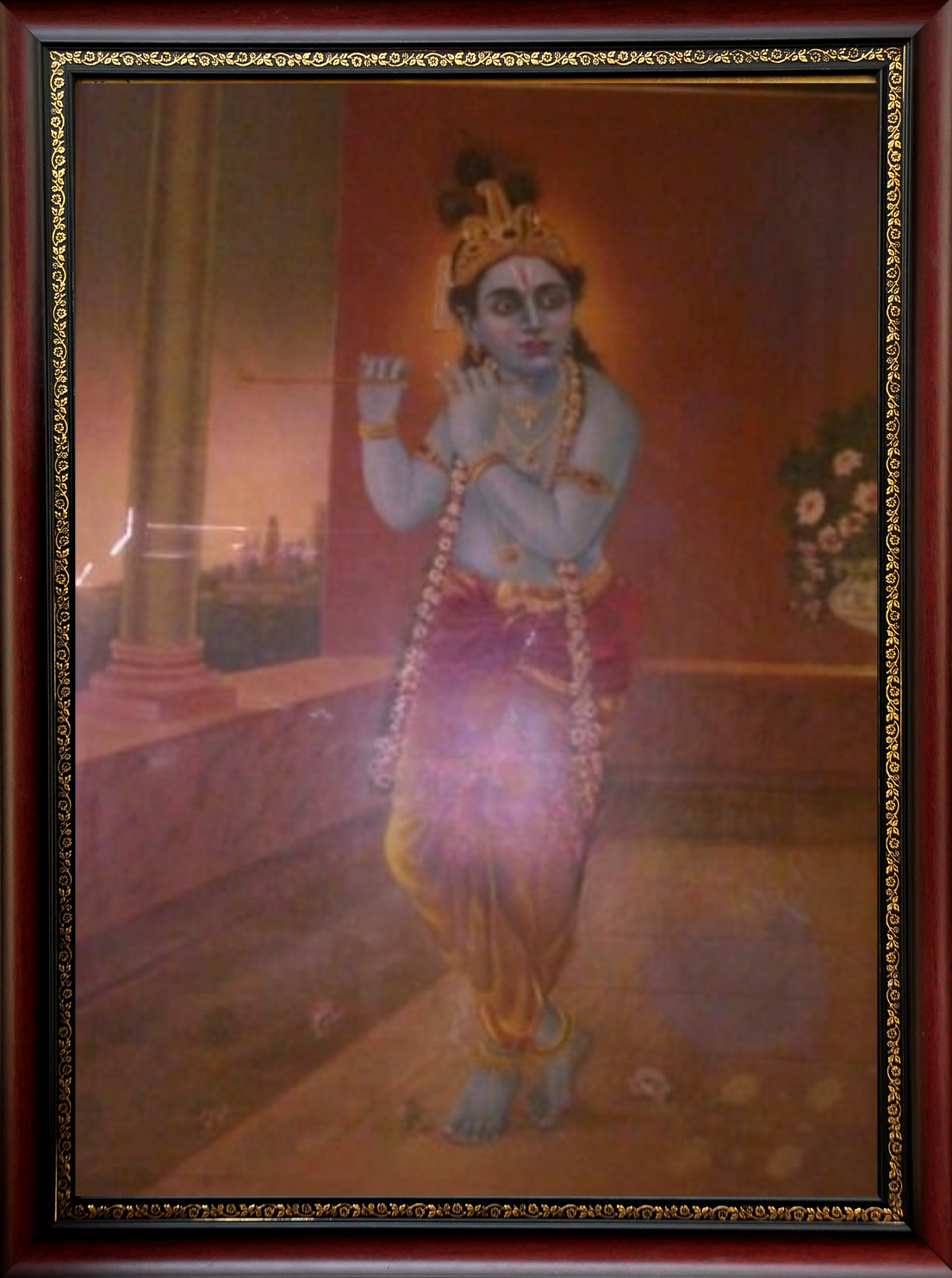
This painting, created in 1926, is one of the earliest representations of Krishna by the artist. A devoted admirer of Lord Krishna, he captured the deity in various themes throughout his work
This artwork stands out among the many Krishna paintings of its time. N. Gopala Rao, a fervent devotee of Lord Sri Krishna, is renowned for his notable works, including Gopikrishna, Mahavishnu, Sri Venkatadri, and other mythological paintings, such as Kalinga Mardhini.
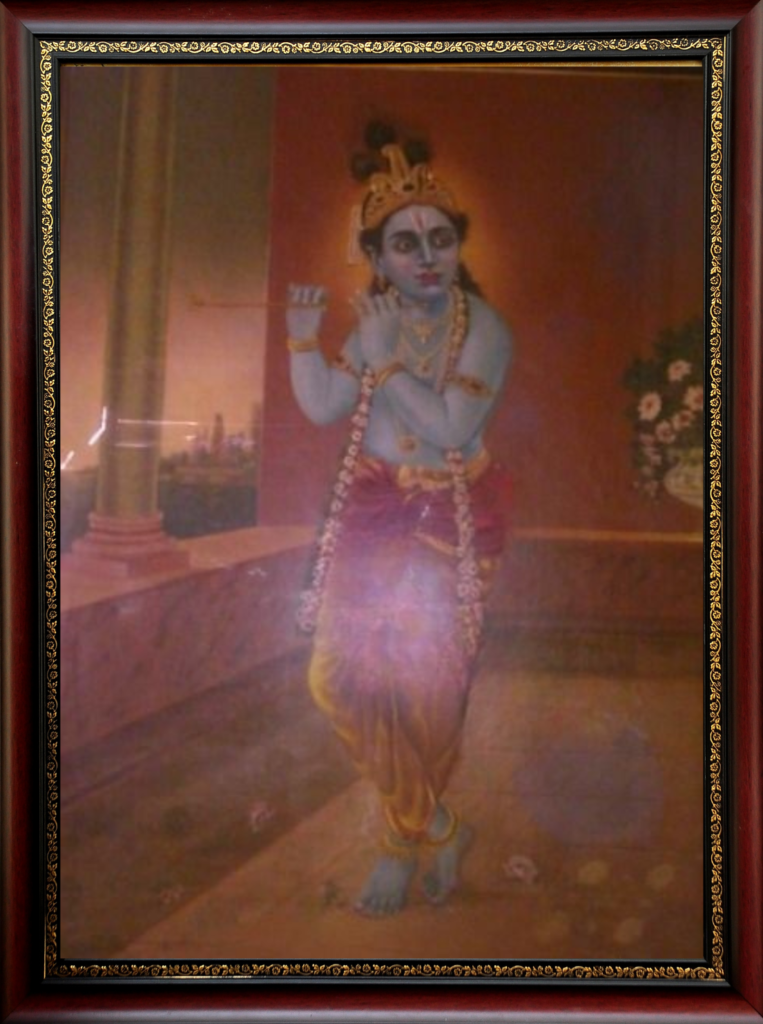
In this captivating painting by N. Gopala Rao, we see Krishna standing gracefully within the serene confines of a building in Vrindavan. His vibrant blue complexion radiates a divine aura, symbolizing his transcendental nature. With one leg elegantly crossed over the other, Krishna exudes a sense of relaxed confidence, embodying both playfulness and composure as he plays his enchanting flute.
The intricate details of his attire draw the eye: a rich yellow dhoti drapes around his waist, while a stunning red sash adds a bold contrast. Adorning his neck is a delicate pink garland, its blossoms capturing the essence of the surrounding beauty. Above his head, three peacock feathers fan out from his crown, each plume a vivid reminder of his connection to nature and the spirit of Vrindavan.
As the sweet notes of his flute fill the air, they create a serene atmosphere, enveloping the room in a sense of peace and devotion. The air is imbued with the fragrance of fresh flowers, enhancing the spiritual ambiance of the scene
In this moment, time feels suspended. Krishna’s expression is one of blissful serenity, inviting all who gaze upon the painting to partake in the love and joy that emanate from his being. Gopala Rao masterfully captures this essence, allowing viewers to immerse themselves in the beauty of Krishna’s presence, where the earthly and the divine unite in harmonious melody.
Painted in 1927
Vilasini
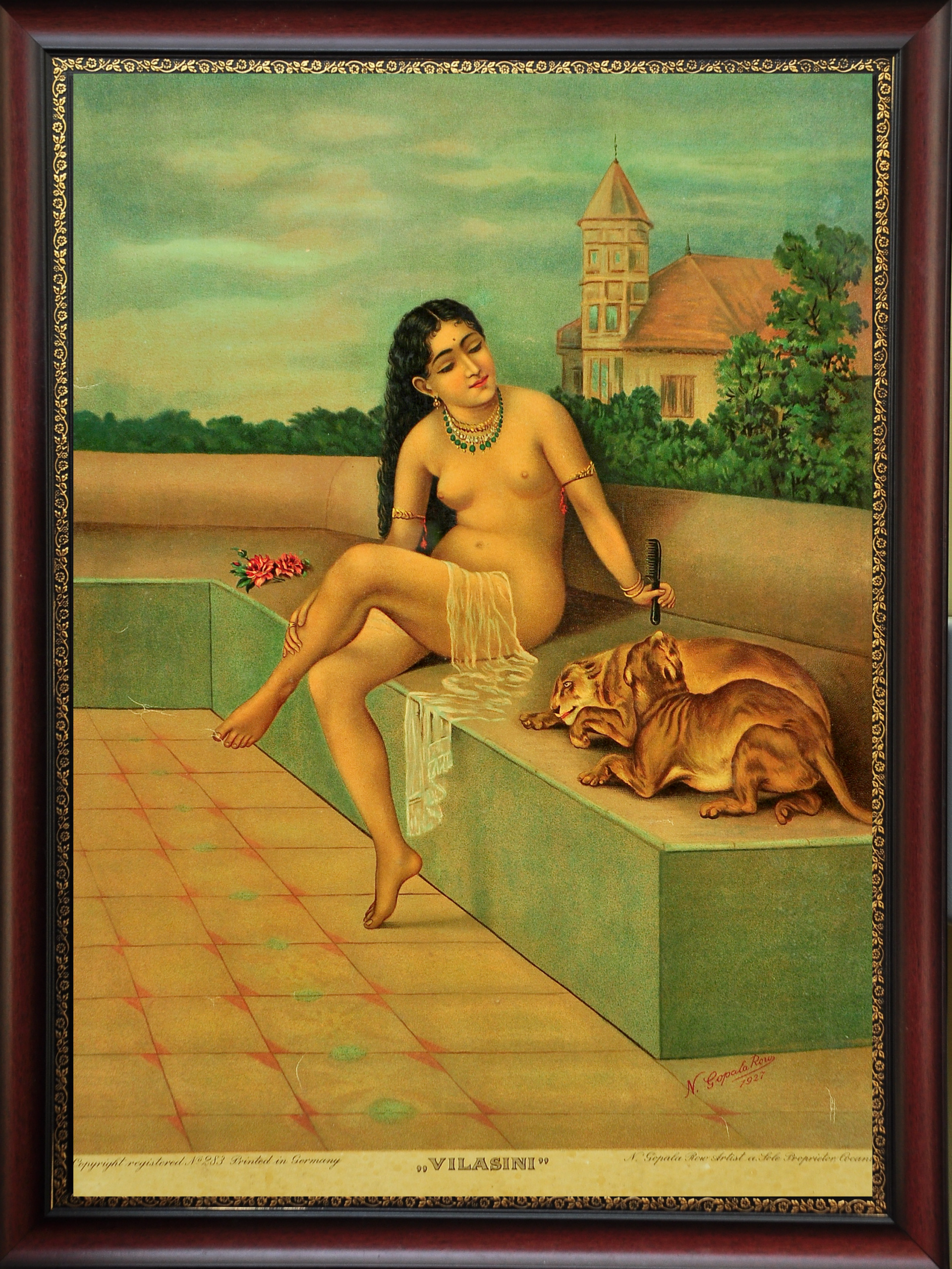
The oil on canvas painting “Vilasini,” created in 1927, is considered N. Gopala Rao’s most brilliant work. He depicted Vilasini as a delicate flower, reflecting his profound love and understanding of women’s fragility and beauty. Gopala Rao was an extraordinarily innovative artist whose contributions significantly shaped the trajectory of Indian art. His ability to capture the expressions of his characters left viewers amazed by the liveliness of his works.
Vilasini, from interpretations of the Mahabharata, is often portrayed as a celestial nymph or dancer who uses her charm to allure Arjuna. Sent by the gods to test his focus and dedication, her enchanting dance serves to highlight themes of desire, duty, and the challenges heroes face amid distractions.
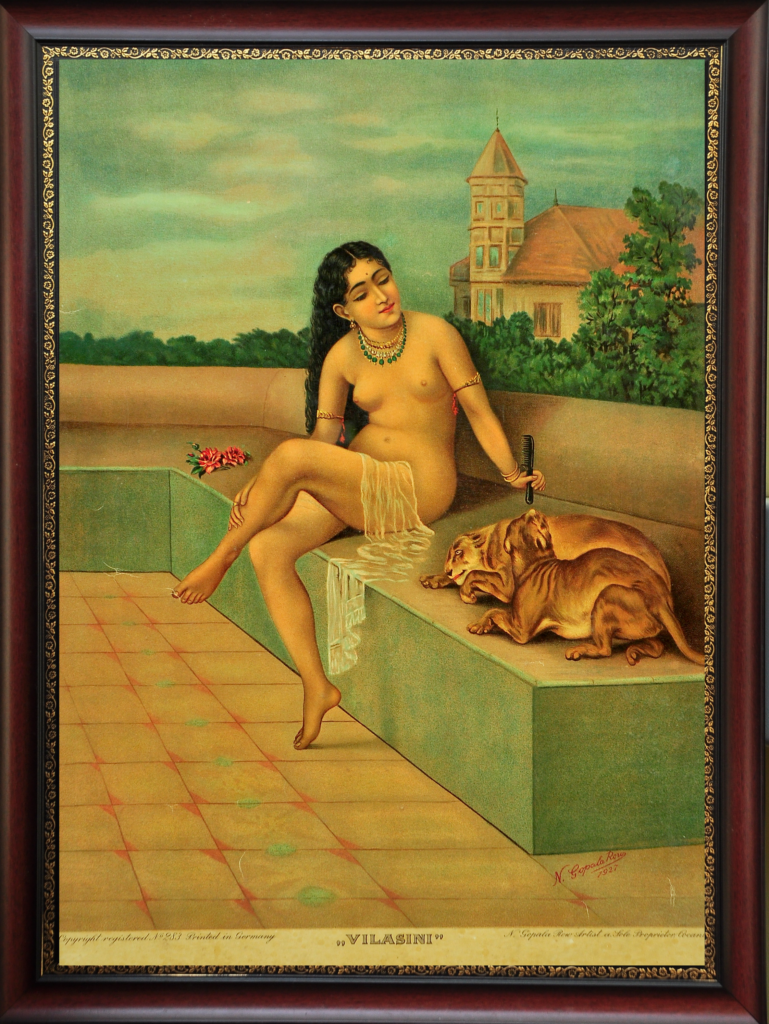
In this captivating painting, Vilasini is depicted as a gracefully nude figure, her long hair flowing freely as she tilts her head toward two playful lion cubs beside her. With one hand resting on her leg and the other holding a delicate comb, she exudes serene elegance. Positioned atop a stone terrace, she is accompanied by two rose flowers nearby, while the lush trees and charming house in the background create a tranquil setting. The vibrant colors and the intricate flooring enhance the beauty of the scene, making this an exceptional work of art. A small, transparent cloth drapes over her leg, and her toes gently touch the ground, adding life to this enchanting moment.
Here’s a more comprehensive look at her character and significance:
Apsara Background: Vilasini is typically portrayed as a celestial nymph (apsara) known for her beauty and grace. Apsaras are often tasked by the gods to distract ascetics or heroes to prevent them from achieving extraordinary powers through penance.
Role in Temptation: Vilasini’s interactions usually revolve around themes of temptation. Her character often embodies the allure of earthly desires, presenting challenges to those on a righteous path. This makes her a symbol of the struggles between spiritual aspirations and worldly attractions.
Connections to Heroes: In Telugu adaptations, Vilasini’s encounters with characters like Arjuna are emphasized. These encounters serve to highlight Arjuna’s strength of character, as he often resists her charms to remain focused on his duties and goals.
Cultural Symbolism: Beyond her role in the Mahabharata, Vilasini represents broader themes of beauty, desire, and the transient nature of life. Her presence in stories reflects the idea that while beauty can be captivating, it is often fleeting and may lead one away from their true purpose.
Variations in Adaptations: Different regional interpretations of the Mahabharata might portray Vilasini with varying degrees of depth. In some narratives, she may have a more significant role, while in others, she serves primarily as a plot device to illustrate moral lessons.
Literary Appearances: Vilasini has appeared in various literary works, plays, and performances in Telugu culture, where her character is used to explore themes of love, duty, and the consequences of desire.
Themes:
Desire vs. Duty: The tension between personal desires and the obligations one has can be seen in Arjuna’s resistance to Vilasini.
Beauty and Illusion: Vilasini’s character serves as a reminder of the ephemeral nature of earthly pleasures.
Conclusion:
While Vilasini may not be as central as other characters in the Mahabharata, her role adds richness to the narrative by highlighting human vulnerabilities and the importance of self-discipline